
The Psychology of Movie Reviews
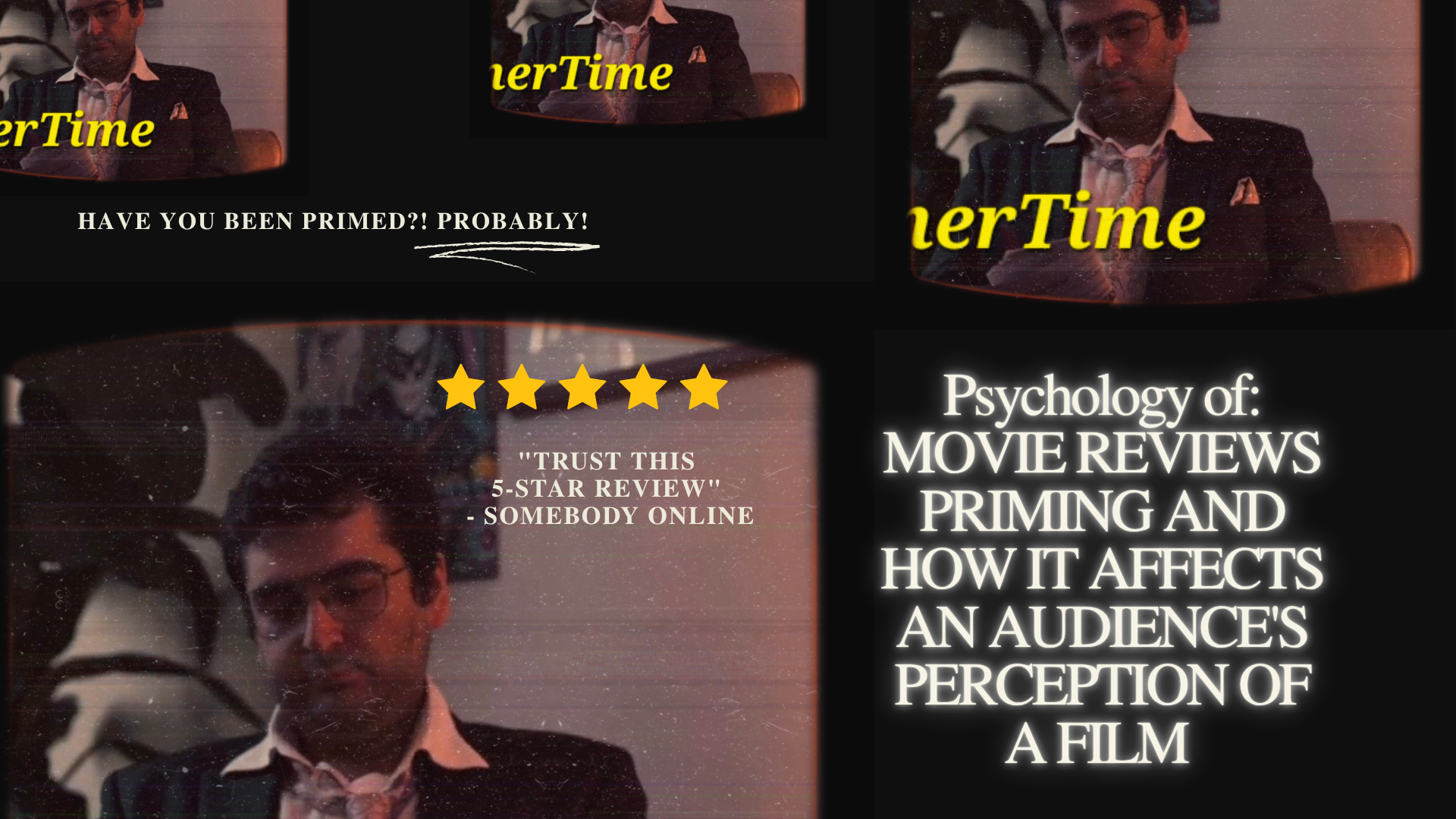
We are often unconsciously influenced by product reviews and advertisements (Pligt & Vliek, 2016). The type of influence we go through is called priming. This is a psychological phenomenon in which we take in certain information before encountering a situation or object, store it, and use it to form an opinion about that situation or object. For example, a review of a vacuum cleaner to see whether it is worth buying or just a waste of money. Priming can affect our brain's reward processing system because external factors influence it; thus, external primes can shape what we like (Campbell-Meiklejohn et al., 2010). I wanted to see if this phenomenon occurred in film, so I dived down a rabbit hole and found that research on the effect of reviews is lacking. So when I broke this study down into sections, I did a deeper dive into priming.
There were multiple types of priming listed, but for the sake of staying on theme, I focused on one type, Positive and Negative priming. Positive priming means our brain processes things faster, so it does not stick with us for long (Example: Seeing a clean hotel lobby before you are given your room keys). Negative priming is when our brain is hit with negative or contradictory information and hits the brakes because it cannot ignore it; it slows processing. And so that information is on loop and stays with us longer (McLennan et al., 2019) (Example: A dirty hotel lobby before we get our room keys). This still did not give me the answer I was looking for. At the start of this study, the aim was to investigate how priming affects liking for a film.
I hypothesized that positive primes would lead to higher liking for a film, and negative primes to lower liking. Participants from a small university in Southern California were randomly assigned to one of three conditions, which I called ‘prime conditions’. All participants were asked to watch a short film clip (2 minutes and 30 seconds) and rate how much they liked it. In the positive prime condition, participants read a brief positive statement, had a positive reviewer rating score on screen, and positive reviews before a clip played. In the negative prime condition, participants read a brief negative statement, a negative reviewer rating on the screen, and negative reviews before a clip. In the control condition, no statement was given about the short film. What I found was that negative reviews did have a significant effect, but when looking at the other two groups, the positive and control groups were the same. Taking a closer look, I concluded that negative reviews had impacted participants' liking of the short film, but positive reviews did not.
This was because of something called negativity bias (Qahri-Saremi & Montazemi, 2023), which occurs when our brain takes in negative information and, since it has trouble ignoring it, it becomes all we can think about. The limitations were the sample size, the fact that 25 individuals knew the investigator, and that the visual primes were not of equal magnitude. If I had to rerun the study, I would make the primes of equal intensity. Based on what I found, I can say that negative reviews had a stronger impact. I believe that this can be useful for marketing research, specifically in the film industry. This could solidify an understanding of how much reviews impact individuals and help to understand what approach to take to lessen the impact of a negative review. Next time you watch a film, let me know, did you watch it because someone told you it was good? Did you avoid it because its reviews were tearing it to pieces?
References
Never miss an issue of Guest Contributions
Get the next one in your inbox. Free, and one click to leave.
0 Comments
No comments yet
Keep reading
A fresh mix from across our archive