The Backrooms: Why does it feel like home?
What happens when the thing chasing you isn’t a monster, but a part of yourself you can’t escape?
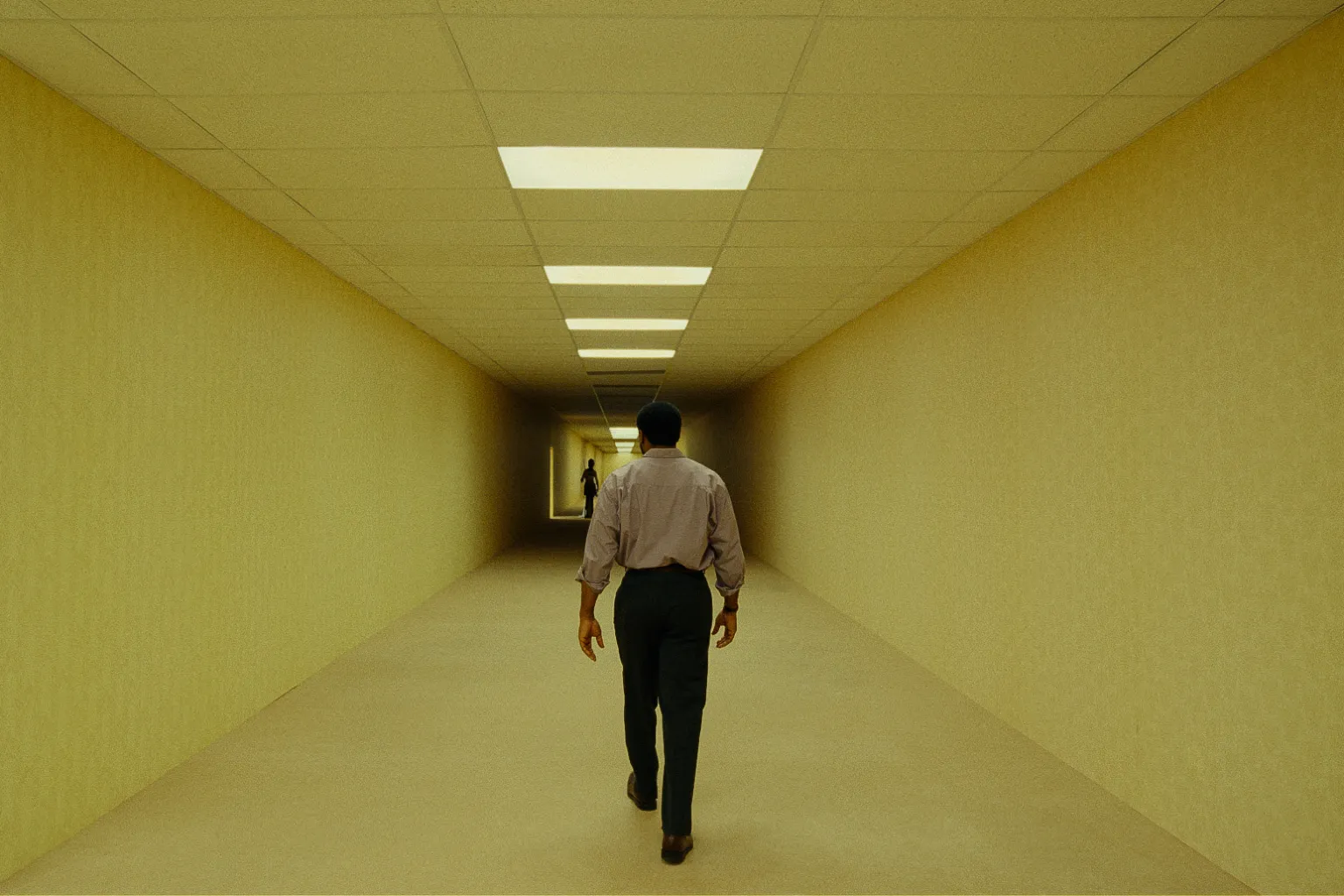
At first glance, The Backrooms feels like a story about being lost and scared. Endless yellow hallways, buzzing fluorescent lights, and creatures lurking just beyond our field of vision to create an environment built entirely on fear and uncertainty. But as the film progresses, something begins to feel much stronger. The Backrooms stop feeling like a place that Clark just wound up in and start to feel like a place that truly understands him.
Which is where it can start to become unsettling.
Because, despite the danger that Clark finds himself surrounded by, there are moments where we as the audience start to shift from him wanting to escape the maze to him wanting to understand it. As he repeatedly descends deeper into the endless hallways, the Backrooms slowly become less foreign. The rooms repeat. The sounds remain consistent. Even the feelings of fear start to feel routine. And routine has an odd way of making us feel a sense of comfort and security.
Psychologically, this matters more than we might think. Humans naturally look for meaning and familiarity, even in seemingly dangerous environments. Research on identity development suggests that our sense of self is shaped not only by our memories and experiences, but by the environments that we inhabit over time (Branje, 2021). These places we occupy begin influencing how we understand ourselves and the world around us as we experience them more.
You can see this connection develop throughout the film. Instead of constantly resisting the maze, Clark slowly begins adapting to it. As reality becomes increasingly difficult to understand, he spends less time questioning the Backrooms and more time learning how to exist within them. The further he goes, the harder it becomes to see where Clark ends, and the maze begins.
What makes this relationship particularly unsettling is that the Backrooms themselves seem to evolve alongside Clark. The space becomes increasingly personal and familiar, as though the environment is responding to his thoughts and emotions. At times, the creatures lurking within the maze almost feel secondary to Clark's connection with the place itself. The real horror no longer comes from what's chasing, but from how comfortable he feels with being lost.
Philosophically, existential thinkers have long argued that human beings search for meaning in worlds that tend to offer none. Faced with uncertainty, we create routines, identities, and belief systems to protect ourselves from chaos. Research discussed in Psychology Today suggests that familiarity often creates feelings of safety, even in environments that are unhealthy or limiting. Meanwhile, environmental psychologists describe “place attachment” as the emotional bonds people form with specific places over time.
Which raises a deeper question.
If our environments help shape who we are, what happens when the place shaping us is built on fear, uncertainty, and isolation? At what point does survival stop being about escape and start becoming about adaptation?
By the end of the film, the monsters themselves almost feel like an afterthought. The real horror isn't necessarily what hides around the corner. It's the possibility that Clark no longer sees the Backrooms as something separate from himself.
Maybe that's why the backrooms feel so unsettling. Not because they're unfamiliar. But because home isn’t always the place we come from. Sometimes it's the place that shapes us, the place we understand, and the place that understands us back.
And maybe the most terrifying thing about the Backrooms isn’t that Clark can’t escape.
Or maybe somewhere along the way, he stopped wanting to.
References
Never miss an issue of The Cognitive Code
Get the next one in your inbox. Free, and one click to leave.
0 Comments
No comments yet
Keep reading
A fresh mix from across our archive