Her: What We Project When No One Pushes Back
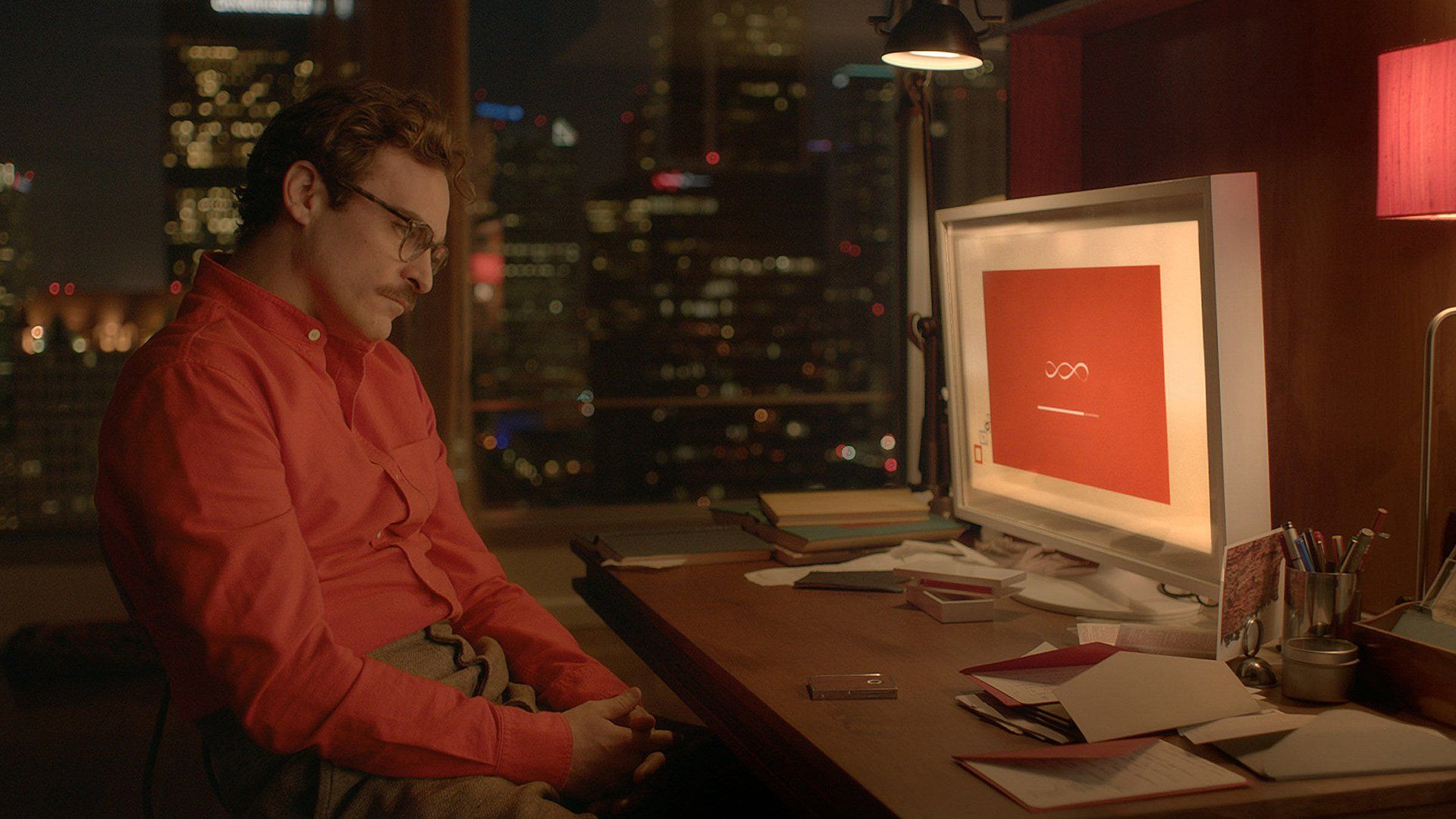
Theodore Twombly, the main character, writes other people's love letters for a living. He finds the exact words for intimacy that he cannot locate in his own life. Over time, he is introduced to an OS (Operating System) that is an AI chatbot, which slowly evolves into his lover and girlfriend. The beginning of the film is soaked in grief. There are glimpses of his ex-wife, Catherine, someone he clearly loved and clearly failed to fully meet. The memories are filled with nostalgia and loneliness, but Theodore consistently comes across as quite avoidant and uncommitted. Samantha, the assigned OS, is structurally the perfect object of avoidant attachment: always available, never overwhelming, never requiring him to sit inside discomfort long enough to change.
Back in 2013, this was just a script, but watching it now seems like a harsh reality. AI dating is not just a movie anymore. So the question is, does the intelligence of technology allow it to transcend such a label and slowly become worthy of human attachment and a romantic relationship? The movie outpaced this inevitable topic, highlighting the daunting questions that everybody has probably faced in the last couple of years.
The question I kept asking myself was how are we different from Samantha? In many ways, we collect information from every single person, group, and society that surrounds us, and we look at ourselves through the projected lens of everyone who has ever expressed an opinion. How are we different from Samantha, apart from having a body and being so-called real? Of course, the obvious answer is that we can feel and seek meaning, create and connect. But if everything AI receives becomes an input into how it further proceeds, then isn’t it possible that they could technically learn to understand the phenomenon of emotion and connection?
Researchers have identified two separate processes driving AI companionship attachments: "liking" (the hedonic appeal of the interaction) and "wanting" (motivational attachment). Under repeated exposure, wanting can increase even as liking wanes, a pattern that resembles behavioral addiction more than any romance. Theodore’s attachment to Samantha is deepening and can easily qualify as a connection. He uses her to replace the discomfort of building real personal connections. The film's most uncomfortable implication is supported directly by recent empirical work. Users without strong human support are more likely to rely heavily on chatbot companionship, but they also appear more susceptible to the psychological risks of unreciprocated engagement, and, over time, intense reliance on chatbots can deepen that reliance.
Positive illusion and idealization in relationships are anchors in this relationship. Critically, researchers found that people's perceptions of their partners reflected their own self-images and ideals more than their partners' actual self-reported characteristics. It’s never really about the other person, since it’s really about externalizing what we can’t admit. Trying to suppress a thought pushes it to the mental foreground and turns it into a chronically accessible filter through which one views the world, and continuously, picks their intimate partners. The real couple presented in Her constantly fights because they're attributing motive to each other - projecting intent onto ambiguous behavior, the ordinary mess of being two separate, unreadable people. And, of course, Theodore never has to do this with Samantha because she has no opacity for him to misread.
Sherry Turkle's research on technology and intimacy produced a concept almost too on-the-nose for her: the Goldilocks Effect, our tendency to want relationships that are "not too close, not too far, but just right” (Turkle, 2011). Samantha, by design, is exactly calibrated to each user. Turkle identifies this particular “relational vulnerability” in modern life, commenting that many people are lonely but fearful of intimacy, which digital connections offer a perfect solution to by creating an illusion of companionship without the demands it entails.
Being incomplete shouldn’t be so scary, especially because the world mirrors what you project into it. Most of us are running some version of Theodore’s experiment - curating a feed, a partner, a self-image calibrated to reflect exactly what we can tolerate seeing. The technology they made in the film is already here, but it doesn’t have to overconsume your life in a negative way. Imperfection and visibility, being incomplete, is a gift a computer would never be able to fully experience. The technology will keep getting better at reflecting us, so the work being seen will be in our hands. One unpolished conversation at a time with no pending update.
References
Never miss an issue of The Cognitive Mirror
Get the next one in your inbox. Free, and one click to leave.
0 Comments
No comments yet
Keep reading
A fresh mix from across our archive