Disclosure Day: Spielberg's Take on Cognitive Dissonance
Steven Spielberg’s new movie Disclosure Day serves as a much-needed addition to the traditional Spielberg-alien blockbuster catalog. While audiences are still engaged with the sci-fi and even action-thriller genres, we are also given a glimpse of what Spielberg believes could be the human response to extraterrestrial beings.
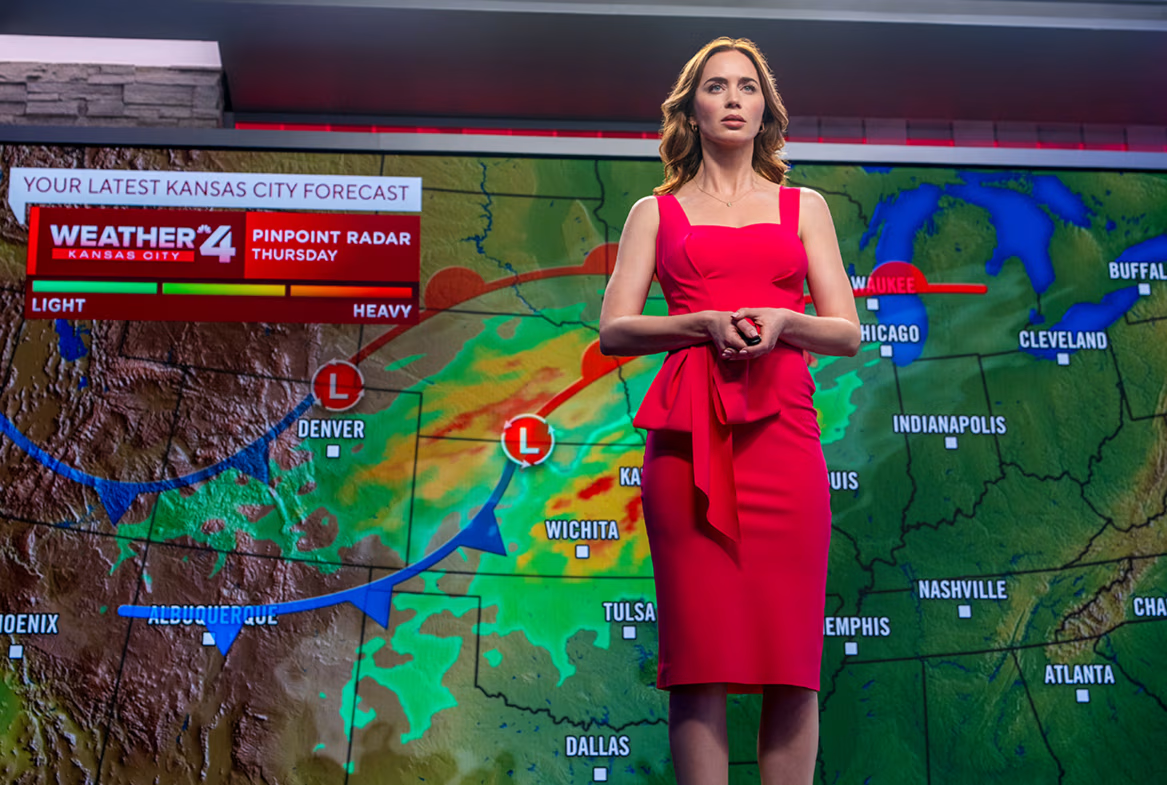
The film urges the public to “listen” and asks, “If someone showed you, proved it to you, would that frighten you?” Through the main characters and the representation of the general public, Spielberg suggests that humans resort to cognitive dissonance when beliefs are challenged. Cognitive dissonance is the discomfort or mental tension an individual has when confronted with conflicting beliefs and values. When an individual is confronted with new information, they often rationalize their beliefs in light of it, feel shame for holding conflicting beliefs, or rely on information that supports their pre-existing beliefs. According to PsychologyToday, while many people could confuse cognitive dissonance with hypocrisy–a contradiction in a human’s belief compared to how one behaves, they differ because cognitive dissonance is more accurately described as a mental state that could result in a lack of trust towards contradicting beliefs.
Spielberg exemplifies these different responses in Disclosure Day. For this film, characters and eventually all of humanity are confronted with the idea that the government has been hiding extraterrestrial beings for decades. An example of cognitive dissonance is represented by the film’s antagonist, Noah Scanlon. As the CEO of a government corporation in charge of extraterrestrial technology, he is openly against the exposure of aliens to the general public, even imposing psychic powers and violence to prevent whistleblowers from spreading this news. At one point in the film, he persuades a whistleblower named Hugo that his plan to expose the truth about alien encounters would lead to societal destruction. Scanlon argues, “It is a virus for which humanity has no cure.”
Spielberg’s commentary on how people who own power and truth over this type of revelation highlights an outcome caused by cognitive dissonance. Humans would maintain their own beliefs, whether right or wrong, while rationalizing their potential contradiction. For instance, Scanlon refuses to admit being wrong, and he goes to extreme lengths to preserve this information. While he justifies himself as saving humanity by preventing mass hysteria, it is evident that he rejects any alternative solution or hearing out the whistleblowers’ perspectives. Spielberg created another example of human response caused by cognitive dissonance through the character of Jane.
When her boyfriend reveals substantial evidence of human-alien interaction, Jane questions the motives behind the whistleblower community. Given this information that has altered her understanding of life on Earth, she immediately takes a stance against contradicting beliefs and relying on her knowledge of religion to stabilize her argument. When confronted with contradicting beliefs, Spielberg portrays humanity as unready and unwilling to face the unknown.
References
Never miss an issue of The Cognitive Mirror
Get the next one in your inbox. Free, and one click to leave.
0 Comments
No comments yet
Keep reading
A fresh mix from across our archive