BoJack Horseman: How Much of Who We Are Is Our Fault?
BoJack Horseman asks one of psychology’s most uncomfortable questions: when does someone’s pain stop explaining their behavior and start excusing it?
If our behavior is shaped by our past, where do we draw the line between understanding it and eventually taking responsibility for it?
At first glance, BoJack Horseman feels like an animated comedy about a washed-up sitcom star struggling with fame, addiction, and adulthood. But as the series unfolds, it becomes clearer to the viewers that this show isn’t really about Hollywood at all. It’s about people. People like us. More specifically, it’s about what happens when someone spends their entire life using trauma as both an explanation for who they are and a reason to believe they can never change.
Which is where these deeper themes within the show become uncomfortable to consume.
Because BoJack Horseman never actually asks us whether BoJack is a good person.
It asks a much harder question.
Can someone be so deeply damaged and still responsible for the damage they cause?
Psychologically, trauma can profoundly influence the way we regulate emotions, form relationships in our lives, and how we overall see ourselves. Childhood neglect, unstable attachment, and repeated emotional wounds often create certain behavioral patterns that tend to follow us to adulthood. According to research on identity development, our experiences play a significant role in shaping who we truly become. But psychology also reminds us that understanding where a behavior comes from is not necessarily the same as removing responsibility for it.
Throughout the series, we slowly begin to understand why BoJack is the way he is. We see the emotional abuse he has endured from Beatrice and Butterscotch, his desperate searches for validation through fame, and the loneliness driving so many of his choices. The show doesn’t reveal these moments just to justify his behavior. It reveals them to help us understand them.
That distinction changes the viewer's entire perception of the show.
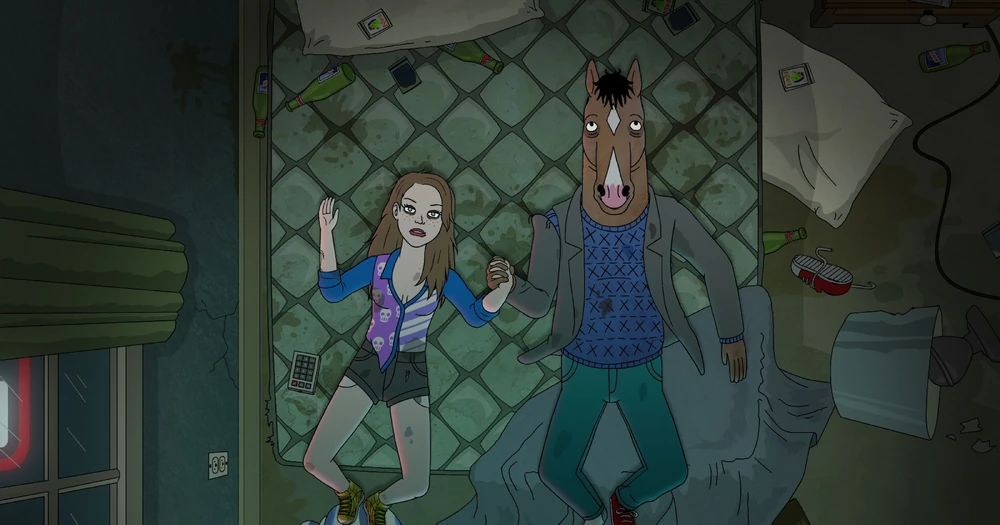
You can see this tension reach its breaking point in the episode “That’s Too Much, Man!” After months of sobriety, Sarah Lynn agrees to go on another drug binge with BoJack, ultimately leading to her death in the planetarium. Even the episode's title, “That’s Too Much, Man!” quietly reflects on the psychology within the episode. The title is delivered like a throwaway joke, but as the episode continues, it almost starts to feel like more of a confession. It’s no longer a phrase to describe a crazy, reckless night. It's about two people who have spent years carrying that unresolved pain, and life itself has become too hard to bear. Throughout the episode, it’s impossible not to sympathize with both BoJack and Sarah Lynn. Sarah Lynn spent her childhood exploited by the entertainment industry, while BoJack has spent years trapped in his own cycle of addiction and self-loathing. They’re both deeply broken, searching for relief in the only ways they’ve ever known.
But sympathy eventually collides with accountability.
When it’s revealed that Bojack waited before calling help, the show forces both him and the audience to confront a painful reality. Trauma may explain why someone makes destructive choices, but it doesn’t erase the consequences those choices have on other people’s lives.
The series returns to this idea in the episode “The View From Halfway Down”, arguably one of television's most haunting representations of guilt, regret, and accountability. As BoJack drifts between life and death, he finds himself seated at a dinner table surrounded by the people he’s lost throughout his life. Each conversation strips away another level of his own denial until all that's left are consequences he’s spent years running from.
One of the episode's most unforgettable moments comes when Secretariat recites The View From Halfway Down describing the instant someone realizes they desperately want to live after it’s too late. The poem isn’t really about death. It’s about clarity. In a single moment, every excuse, every justification, and every attempt to blame the past completely disappears. What remains is the realization that our choices matter long before we are forced to face them.
The episode doesn’t punish BoJack.
It simply refuses to let him hide anymore.
And I think that's one of the most compassionate things the show could have done.
Rather than portraying him as a villain or a victim, BoJack Horseman allows him to exist as something much more than human, someone capable of carrying profound trauma while also being able to cause profound harm. The audience isn’t able to forgive him, nor are they asked to hate him. Instead, they’re asked to sit with a far-from-uncomfortable truth, and it’s that empathy and accountability can exist at the same time.
Maybe that’s why BoJack Horseman resonates with so many different people.
Not because we’ve all made the same mistakes as BoJack, but because we’ve all spent time trying to understand the people around us and ourselves.
One of the show’s greatest qualities is that it refuses to let any character exist only as one thing. Diane struggles with depression and a lack of purpose. Princess Carolyn sacrifices herself while constantly trying to hold everyone else together. Todd spends years searching for belonging and self-worth. Sarah Lynn never truly escapes the childhood she was robbed of. Even BoJack’s parents, despite the pain they both cause, are eventually revealed to be products of their own unresolved trauma.
The series quietly reminds us that everyone is carrying something.
Whether you’re the main character or someone who appears for only a single episode, everyone is fighting battles we often know nothing about.
But it also reminds us that pain isn’t permission.
Understanding someone’s story doesn’t erase the impact they have on people around them. Maybe that’s the real lesson BoJack Horseman leaves us with. Empathy and accountability were never meant to compete with one another. The people around us deserve to have their stories understood. They also deserve to be protected from the harm those stories can sometimes create. Because perhaps healing isn’t about pretending our past didn’t shape us. It’s about refusing to let it become the only thing that defines who we choose to be next.
References
Never miss an issue of The Cognitive Code
Get the next one in your inbox. Free, and one click to leave.
0 Comments
No comments yet
Keep reading
A fresh mix from across our archive