
Adolescence: The Hidden Influence of Media
Adolescence made everyone question from the very start whether Jamie Miller was innocent or guilty. But the show isn’t really interested in that question. What it’s scrutinizing is something more disturbing: the toxic culture infiltrating children's social media feeds and how seemingly harmless a child can look while being influenced by it.
Jamie drew pictures, had a family that seemed as ordinary as any other, and was portrayed as an innocent thirteen-year-old. Before we knew what he was capable of, we were brought to sympathize with him, and that’s exactly the point. The show conveys that radicalization doesn’t need drastic signs to show itself, just a developing mind and enough exposure to the right content.
Cultivation theory, developed by George Gerbner, suggests that repeated exposure to media gradually changes how we see the world. Jamie didn’t wake up one day with a distorted view of reality, nor was he explicitly told to adopt this manosphere ideology; rather, his perception of girls, relationships, and worth was slowly shifted by his algorithm feeding him the same content over and over. This is shown specifically when Jamie casually explains to Briony that “80% of women are attracted to 20% of men,” and soon admits he believes it, revealing how his own judgment is being shaped by what he’s absorbed online.
And what’s even more uncomfortable is that Jamie wasn’t the only one. When Bascombe stood across from his son, Adam, he didn’t understand the coded emojis and references the way most students at the school did and had to have them explained to him. The jokes being made in the hallways were clearly normalized. Popularity was a clear drive in this school, and no one challenged anything, specifically fitting into the ideas their feeds were teaching them. The leaked photo of Katie that circulated through the school and the following mockery is a clear example of how this misogynistic online culture moved directly from screen to reality, showing the real effects media can have on a whole community.
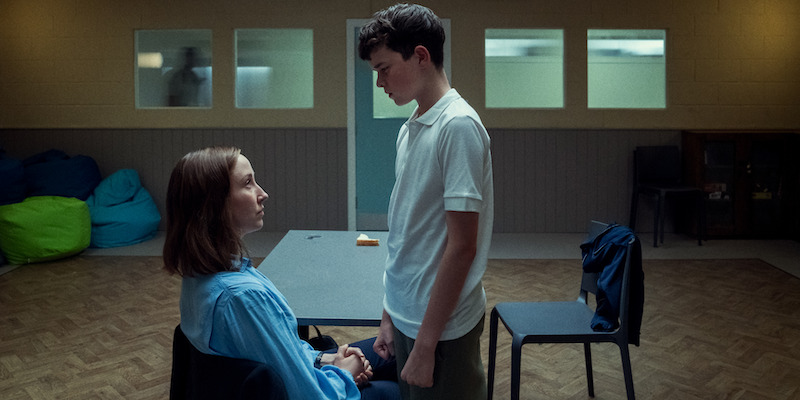
Yet these effects aren’t noticeable to the very people affected by them. When Jamie was questioned by the psychologist, he was unable to confront what he had actually done, constantly deflected, made himself seem better than the boys around him, and avoided the main issue entirely. It shows how deeply absorbed he had become, to the point of being completely unaware of what was wrong with his actions. Revealing just how far media influence can go. This influence becomes evident in episode three, where Jamie’s conversation with the psychologist Briony makes it clear.
The conversation starts with Jamie questioning the rules of the conversation they’re having, trying to get more information about his verdict. However, the control is soon lost while Jamie’s guilt starts to reveal itself in sudden justification and deflections. He only fully snaps once she starts insisting he sit down, suddenly demeaning the way she speaks to him in an angry rage. While she sits in utter shock, caught off guard, he seems to want her to be afraid of him and his actions, to see if he can make her feel powerless, until a guard has to intervene. This further insinuates the idea that this way of acting has been conditioned into him through the media he consumes, shifting his perception of women and teaching him to view them as lesser.
The final episode shows Jamie’s parents struggling to understand how their son could have committed this crime, further reflecting the same gap in understanding we see when Bascombe sits across from his own son. This gap in parental awareness of what children consume online brings a broader concern about how these platforms operate and who is truly responsible for what reaches developing minds. And that’s what Adolescence is about, not just one boy who did something horrific, but a generation of children consuming content at their own expense.
References
Never miss an issue of Guest Contributions
Get the next one in your inbox. Free, and one click to leave.
0 Comments
No comments yet
Keep reading
A fresh mix from across our archive