A Quiet Place Is Loud: How Silence Can Be Heard
In A Quiet Place, danger hides inside the absence of sound. From the family's permanent hypervigilance to the birth scene where one sound could cost two lives, the film reveals how silence is a constant, exhausting act of threat detection in disguise.
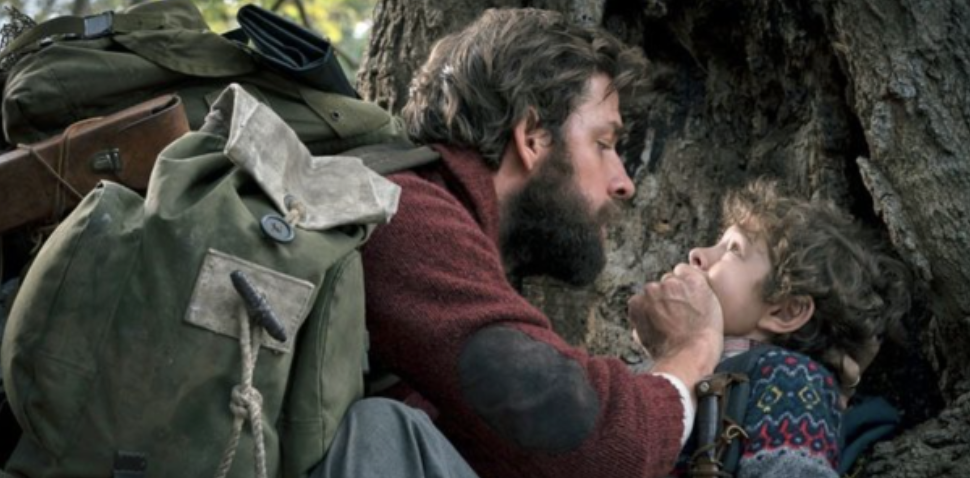
In A Quiet Place, silence is the sound of the danger you haven't found yet.
Every horror movie has taught us the same lesson: fear announces itself. A creaking hinge, stinger chord, or a scream in the dark. A Quiet Place breaks that rule intentionally. Here, the threat is everything before the sound. The silence itself is the thing your nervous system must survive, because silence, it turns out, isn't nothing. Recent perception research shows that people don't just infer silence the way they infer an empty room. They perceive it directly, the same way they perceive a sound, including illusions (Goh, Phillips, & Firestone, 2023). Silence has texture and duration, and surprisingly the ability to lie. A Quiet Place turns that fact into a survival mechanism, and then into a weapon.
To begin with, the film inverts the genre's basic grammar. Ordinarily, sound warns and silence relieves. Here, a snapped twig is a death sentence, and the quiet stretch before it is the actual danger, because the quiet is where the creature could already be standing. A dropped can, a creaking staircase, or a child's toy left on; all land with the force of a jump scare, because the film spent the previous ten minutes teaching you that any sound at all is unbearable. The stinger here is a footstep, not a startling sound. That's the flip: the more silent the world gets, the louder every single sound becomes, until a pin drop carries the same narrative weight most films reserve for a gunshot.
Next, that inversion produces a very specific kind of dread in the audience, because it mirrors something real about how the brain treats novel stimuli. Research on the orienting reflex shows that the brain automatically snaps attention toward anything new or potentially meaningful the instant it appears (Sokolov, 1963). In an ordinary, noisy environment, a faint sound gets lost in the mix and is easy to ignore. In total silence, the faint sound becomes the only signal in the room, and the brain has no choice but to treat it as maximally important. Watching the Abbott family sit in silence is like watching a household of nervous systems locked permanently at attention, because in their world, every silence is a held breath, and every held breath is doing the involuntary work of a threat detector that never gets to power down, leaving their sympathetic nervous systems always running.
Furthermore, staying alive in that world means running a constant, exhausting calculation. Signal detection theory describes exactly this kind of cost wherein when you're monitoring for a rare but catastrophic signal, every judgment call carries outsized consequences, and there's no way to just relax your vigilance without risking a fatal miss (Green & Swets, 1966). In this world, misjudging a faint sound costs a life. Every character in A Quiet Place is functioning as an involuntary signal-detection system, forced to sort a meaningless creak from a lethal one in real time, with no room for error and no way to turn the system off. The film's tension comes from watching how mentally exhausting it is to never be allowed to stop listening.
Ultimately, the film's most devastating scene makes this literal instead of atmospheric. Evelyn gives birth in near-total silence, biting down on pain that would, in any other circumstance, be screamed through. Here, one sound could kill her and the baby both. The wincing and the suffering are silent. In this situation, life enters the world through a silence more agonizing than the pain that produced it, and the moment becomes both a literal survival tactic and an exact metaphor for the film’s themes. Outside that scene, the family's sand-covered paths, their sign language, their board games swapped for silent equivalents, are real adaptive strategies for reducing acoustic risk while still holding a family together, also thereby proving that connection doesn't require noise, only attention.
The horror in A Quiet Place stems from a room, a breath, and a body that couldn't stop listening for what wasn't there yet. That's the loudest aspect of the whole film.
References
Never miss an issue of The Cognitive Flix
Get the next one in your inbox. Free, and one click to leave.
0 Comments
No comments yet
Keep reading
A fresh mix from across our archive